AI Data Security for Modern Teams

Fortra makes AI adoption safe, scalable, and swift

We believe data should drive innovation, not fuel fear. Security exists to enable growth, not slow it down.

With advanced data security for AI, your team can safely leverage artificial intelligence. Discover how to secure your data from AI with Fortra.
SCHEDULE A DEMO

Fortra platform demo


Watch self-guided demo >

Granular AI Data Protection Controls

AI security requires an advanced system that can handle three interconnected challenges. With Fortra AI Data Loss Prevention (DLP), you control how your sensitive data is protected.

Image
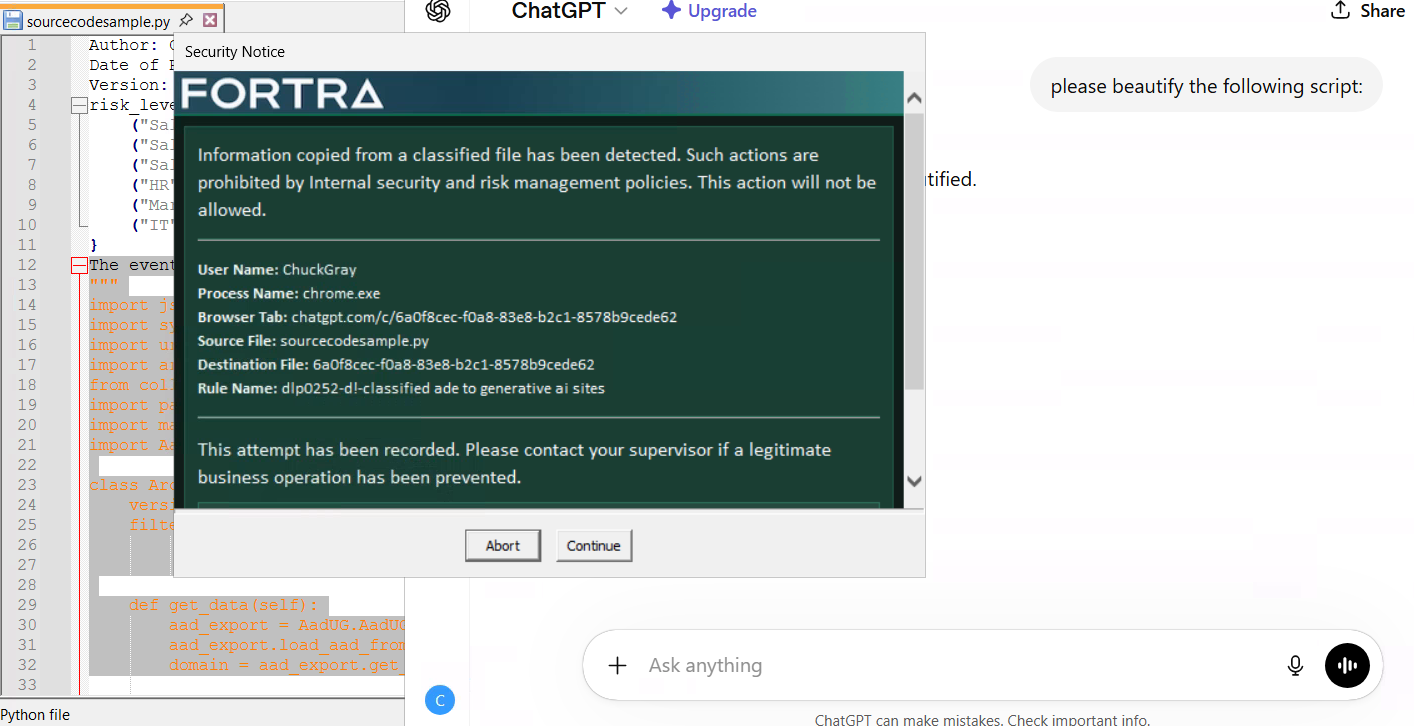
Chat GPT File Upload Alert


Flag Patterns

Monitor and block questions submitted to AI sites based on sensitive data patterns

Block Classified Data

Prevent copying and pasting of classified data.

Outright Block

Restrict all traffic to generative AI sites for maximum security.

Text

Fortra Data Security: 20+ Years Protecting Critical Data

Image
High-Powered DLP, Supported by Experts Who Have Your Back

A trusted leader in the data protection fieldCyber Security Winner 2026

Image
Data Risk Assessment, powered by DSPM.

Gain complete clarity on your cloud data landscape with a 30-day Data Risk Assessment, powered by DSPM.


Get Started

Fortra Data Security for AI

Fortra Data Security can block data egress via AI sites right out of the box with our Generative AI Content Pack.

This provides DLP solutions and reporting templates to allow users to use generative AI sites while preventing the egress of classified data via copy-and-paste, file upload, or form submission.

Our Generative AI Content Pack also includes a workspace within our Analytics and Reporting Cloud (ARC) to allow for reporting on key data points such as:

  • Volumes of events by users
  • Types of data egressed (PII, PCI, etc.)
  • Most common file types being shared via AI sites
  • Operation types such as copy-paste or file upload
  • Top sites where egress is occurring
Image
ARC_SSE_Dashboard

ARC dashboard offers insights on data egress and AI site activity.

Image
Free DLP Datasheet

Why "Free" AI Data Loss Prevention Isn’t Enough

So-called "free" solutions with hidden fees may seem cost-effective at first glance, but their limited capabilities often undercut efforts to protect against the complex risks of AI-driven data loss—that is, unless you pay up for extra features. 

Read our datasheet to discover how our purpose-built AI DLP platform with predictable, transparent pricing and robust features is the best way to protect your data and budget.

Read Datasheet

We are at the leading edge of not only the use of AI Chatbots but understanding the shortcomings and implications. Since each company has their own tolerance for risk, tools need to provide the flexibility to allow a company to ease their way into these environments. As cases in the US court system have already shown these learning models do not discriminate, be it personal commentary or intellectual property, all data is fair game, and we need to protect what we own.

Director of Product Data Protection, Fortra

See How Fortra AI Data Security Protects Business

Request a personalized demo to explore our powerful, purpose-built AI data security solutions.

Request a Demo

FAQs about AI Data Security Platforms

Cybersecurity protects systems, networks, and data from various threats. AI data security specifically addresses the use, sharing, and exposure of sensitive data within AI systems. 

While cybersecurity includes tools such as network protection, endpoint security, and identity management, AI data security adds controls designed for AI-driven environments: 

  • Shielding sensitive data used in AI models and prompts. 

  • Monitoring how data flows into and out of AI tools. 

  • Preventing data leakage via user interactions like copy-paste or file uploads. 

AI systems create risks that traditional security may not address. Without additional controls, attackers can exploit how these systems are trained and operated. 

Common AI security risks include:

  • Adversarial attacks: Inputs designed to trick machine learning models into producing harmful or incorrect outputs. 

  • Prompt injection attempts: Manipulated inputs that cause generative AI tools to return unsafe or unintended responses. 

  • Data poisoning: Altered training data that leads to inaccurate predictions or degraded performance. 

Standard cybersecurity controls still play an important role, but they do not fully address how data interacts with AI systems. Data security for AI adds additional layers of protection: DSPM identifies and classifies sensitive data and DLP enforces controls to prevent that data from being exposed during training, deployment, and real-time use. 

AI systems power tools across industries, including chatbots and analytics in finance and healthcare. As adoption increases, these systems become prime targets for attackers trying to steal data, disrupt operations, or undermine trust. 

Data breaches demonstrate that even well-protected organizations can experience significant losses. Although not all attacks include AI, these incidents emphasize the risks of managing sensitive data at scale. 

AI expands the attack surface by exposing cloud environments, training data, and model behavior to new risks exceeding traditional controls. As a result, AI data protection is indispensable for organizations handling sensitive information. 

If AI systems in critical sectors are compromised, the impact can go beyond data loss to operational disruption and damage to reputation. 

Data security for AI applies multiple layers to detect threats, protect systems, and enable rapid response. 

  • Threat detection and anomaly scoring: AI systems identify normal behavior and flag unusual activity, including unexpected traffic or unfamiliar access attempts. 

  • Automation and response: Automated controls can disable compromised accounts, isolate systems, or alert security teams before threats escalate. 

  • Protecting AI pipelines: DSPM identifies and classifies sensitive data across systems, while DLP enforces controls to prevent that data from being exposed through AI tools. 

  • Periodic audits and updates: Ongoing monitoring, updates, and retraining help address developing threats and preserve performance. 

Many organizations use an AI data security platform to enforce these controls. 

Effective data security for AI relies on consistent controls for data, access, and system management. 

  • Secure data collection and transfer: Encrypt data at the source and while in transit to prevent interception. 

  • Control access at every stage: Use role-based permissions to ensure only authorized users can access or modify AI systems. 

  • Use threat simulations: Test systems exposed to attacks such as data poisoning and prompt injection to uncover vulnerabilities early. 

  • Monitor activity and respond quickly: Use detection tools to flag unusual behavior and address issues quickly. 

  • Update and retrain models regularly: Incorporate new data and address known vulnerabilities to reduce risk. 

  • Establish responsible AI practices: Document processes, assess ethical risks, and comply with regulations to maintain trust and accountability. 

These steps form the foundation of AI data loss prevention platforms (AI DLP), which help prevent exposure of sensitive data through AI tools. 

An AI data security platform is a centralized system that enables organizations to monitor, control, and defend sensitive data used in or exposed to AI tools. It integrates data visibility, policy enforcement, and threat detection to reduce chances of data loss across AI environments. 

AI data security companies typically offer several core functions: 

Data discovery and classification 

These platforms identify where sensitive data is stored across systems and label it by risk, such as PII, financial data, or intellectual property. 

Monitoring AI interactions 

They track data usage in AI tools, including prompts, file uploads, and outputs, to detect risky behavior or policy violations. 

Policy enforcement and controls 

They enforce rules to prevent sharing sensitive data with AI systems, such as blocking copy-paste actions, restricting uploads, or limiting access to specific tools. 

Threat identification and response 

They flag unusual activity, such as large data transfers or suspicious prompts, and trigger automated reactions, such as alerts or access restrictions. 

Reporting and analytics 

They provide visibility into data flows within AI systems, helping teams understand usage patterns and identify potential risks. 

By combining these protections, an AI data security platform enables organizations to adopt AI tools while preserving control over sensitive data.